Development and optimization of a
dual sensor system with real time digital signal processing for the detection
and identification of buried landmines and unexploded ordnance - MINESEYE
Funding: ESPRIT, Project: 29958
Coordinator:
EPPRA SARL, France, Project manager: Dr. Peter Choi
Partners:
X-technologies - Ecole
Polytechnique, Palaiseau, France, Project
responsible: Dominique de Lapparent
INOE 2000, Romania, RO
Project manager: Dr. Viorel Braic
John Caunt Scientific
Ltd., Oxford, U.K. project manager: Eng. John Caunt
Menschen
gegen Minen – MgM, Germany
Project manager: Eng. Michael Ehlers
OBJECTIVES
The MINESEYE system is a dual detection system using:
Digital induction pulse sensor for advanced metal detection - DIPS
and
System for explosive detection following exposure to a pulsed
neutron beam via gamma radiation signature of constituent elements – Pulsed Neutron
Chemical Analysis Sensor – PNCAS.
DIPS
is composed of two parts, the search head unit and the control and data
processing unit.
The
data processing and human interface unit makes up PNCAS, while the neutron
generator head with integrated gamma detector is its separate component. In
addition to the precise pulsed power unit and the neutron tube, it contains the
gas control system, power electronics, and local energy storage.
The
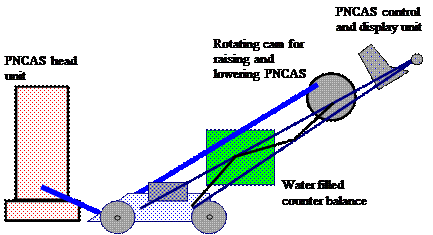
man portable version: the device mounted atop a hand-pushed, self-propelled modified
lawnmower. The operator is supposed to stand about 2 m behind.
 The
PNCAS head is to be raised and lowered between the transport and detection
modes on the modified lawnmower, with the detector head positioned as close to
the ground as feasible, for optimised sensitivity.
The
PNCAS head is to be raised and lowered between the transport and detection
modes on the modified lawnmower, with the detector head positioned as close to
the ground as feasible, for optimised sensitivity.
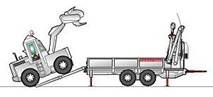
Transport system of the whole system in the mined areas (Angola
and Namibia)
I.
Specific Objectives - INOE 2000
1. PNCAS LABORATORY UNIT – DESIGN AND
MANUFACTURING
• CAD drawings
• Inner electrodes super finishing and
thin film deposition
• He mass spectrometry leak
detection of components
•
Ion source position
•
Target position
•
High voltage insulation
2. GAS HANDLING IN THE NEUTRON TUBE
SIMULATOR
Since
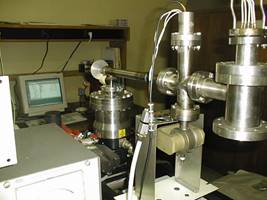
the laboratory unit isn't meant to be sealed off, a turbo pump-powered pumping
unit will be supplied. An electrovalve is used to
pulse the working gas.
 II.
Contribution of INOE 2000
II.
Contribution of INOE 2000
UHV chamber and pumping unit supplied for the pulse neutron tube
generator
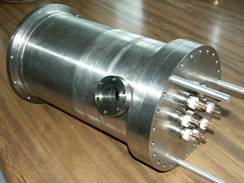
The manufactured pulse neutron tube generator after the
pressure-time evolution in a gas-pulsing regime was examined
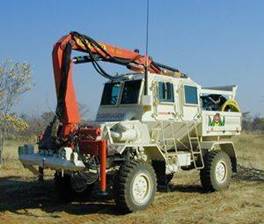

 Field tests of the
neutron tube generator in Afrika, conducted by MgM
partner
Field tests of the
neutron tube generator in Afrika, conducted by MgM
partner